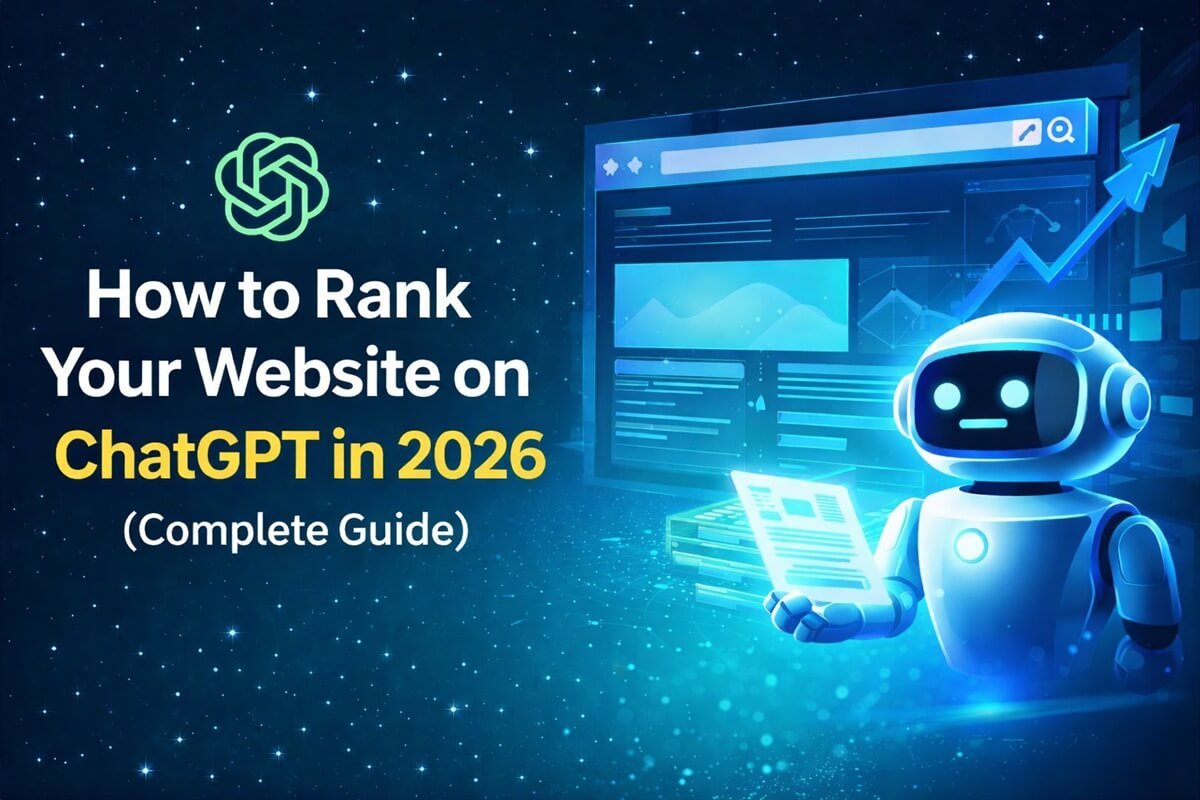
Artificial Intelligence is transforming how people search for information online. Instead of only relying on traditional search engines like Google, users are now asking questions directly to AI tools like ChatGPT, Gemini, and other AI assistants.
In 2026, ranking your website is no longer limited to Google SERPs. Businesses now want their websites to appear in AI-generated answers as well.
So the big question is:
How do you rank your website on ChatGPT in 2026?
The answer lies in a mix of SEO, content authority, structured data, and brand trust.
In this guide, you will learn practical strategies that help your website become visible in AI search results and AI-generated answers.
Understanding How ChatGPT Finds Website Information
Before trying to rank on ChatGPT, it’s important to understand how AI tools work.
ChatGPT does not crawl websites in real-time like Google. Instead, it generates answers using:
- High-quality training data
- Trusted web sources
- Authoritative websites
- Structured knowledge sources
- Publicly available web content
If your website appears frequently across trusted platforms and contains high-value, structured, and informative content, AI tools are more likely to reference or summarize it.
That is why AI SEO is becoming the next evolution of search optimization.
Why Ranking on AI Platforms Matters?
AI-powered search is growing rapidly. Millions of users now ask questions like:
- Best SEO agency in India
- How to fix iPhone screen
- Best digital marketing strategies
- Affordable pizza franchise in India
Instead of clicking multiple links, users receive direct answers from AI tools.
If your website becomes a source for those answers, you gain:
- Massive brand exposure
- Free targeted traffic
- Higher authority
- More leads and conversions
For businesses, this means AI visibility is the new SEO battleground.
1. Create High-Quality, Helpful Content
The most important factor for ranking on AI platforms is helpful content.
AI tools prefer websites that provide clear, accurate, and informative answers.
Your content should:
✔ Solve user problems
✔ Provide step-by-step guidance
✔ Include examples and explanations
✔ Be easy to understand
✔ Avoid unnecessary fluff
Instead of writing short blog posts, create comprehensive content that fully answers a topic.
For example:
Bad content:
“SEO tips for beginners”
Better content:
“15 Advanced SEO Strategies That Actually Work in 2026”
Long-form, informative content increases the chances that AI systems will use your information.
2. Use Question-Based Content
Most AI searches are question-based.
Users typically ask things like:
- How to rank a website on ChatGPT?
- What is AI SEO?
- How does ChatGPT search work?
This means your content should include clear questions and answers.
Best formats include:
- FAQ sections
- How-to guides
- Tutorials
- Comparison articles
- Step-by-step processes
Example:
H2: How Can a Website Rank on ChatGPT?
Then provide a clear, structured answer.
This makes it easier for AI tools to extract and summarize your content.
3. Build Topical Authority
One blog post is not enough.
AI models prefer websites that demonstrate deep expertise in a topic.
Instead of writing random blogs, build topic clusters.
Example for SEO niche:
Main topic:
SEO in 2026
Supporting content:
- AI SEO strategies
- Technical SEO checklist
- How to rank on ChatGPT
- How to optimize for voice search
- Schema markup guide
- Content optimization techniques
When your website has multiple related articles, AI tools recognize it as a trusted knowledge source.
4. Optimize for Traditional SEO First
Even though we are discussing AI platforms, Google SEO still matters.
Most AI tools learn from the web, and high-ranking pages often become trusted references.
Focus on:
- Keyword research
- High-quality backlinks
- Fast page speed
- Mobile-friendly design
- On-page SEO optimization
- Internal linking
If your website ranks well on Google, it increases the likelihood that AI systems will also use your content.
5. Use Structured Data (Schema Markup)
Structured data helps machines understand your content better.
Schema markup tells search engines:
- What your page is about
- Whether it contains FAQs
- Product information
- Reviews
- Business details
Useful schema types include:
- FAQ schema
- Article schema
- Organization schema
- Local business schema
- How-to schema
Structured data improves your chances of being used in:
- Google featured snippets
- Voice search
- AI-generated responses
6. Get Mentions Across the Web
AI tools trust brands that appear across multiple sources.
Your website should be mentioned on:
- News websites
- Blogs
- PR platforms
- Industry directories
- Social media platforms
The more your brand appears across the internet, the more credible your website becomes.
This is similar to digital PR and brand authority building.
7. Optimize for Natural Language
AI systems understand natural human language, not just keywords.
Avoid writing content that looks like this:
❌ “best seo agency india cheap seo services seo company india”
Instead write naturally:
✔ “Looking for the best SEO agency in India? Here’s how to choose the right one for your business.”
Natural writing improves:
- User experience
- AI readability
- Engagement
- Content trustworthiness
8. Keep Content Updated
AI tools prefer fresh and updated information.
Old articles with outdated data may lose visibility.
Best practices:
- Update blog posts regularly
- Add new statistics
- Refresh examples
- Improve outdated sections
- Add new insights
Updating content signals that your website is active and reliable.
9. Build a Strong Brand Presence
AI tools are more likely to reference recognized brands.
To build brand authority:
- Publish expert blogs
- Share insights on LinkedIn
- Appear on industry platforms
- Publish research or case studies
- Build social proof
Over time, your brand becomes a trusted knowledge source.
10. Focus on E-E-A-T
Google introduced the concept of E-E-A-T:
- Experience
- Expertise
- Authoritativeness
- Trustworthiness
These signals are also important for AI platforms.
You can improve E-E-A-T by:
- Showing author information
- Adding real experience
- Using credible sources
- Including case studies
- Publishing original insights
The stronger your credibility, the higher the chance that AI tools will trust your content.
The Future of SEO is AI Visibility
SEO is evolving rapidly.
In the past, ranking meant appearing on Google’s first page.
Today, the goal is broader:
✔ Google ranking
✔ Featured snippets
✔ Voice search
✔ AI assistants like ChatGPT
Businesses that adapt to AI SEO strategies early will gain a huge advantage.
Instead of focusing only on keywords, focus on:
- Helpful content
- Brand authority
- topical expertise
- structured data
- digital PR
This combination makes your website AI-friendly and future-proof.
Final Thoughts
Ranking on ChatGPT in 2026 is not about gaming algorithms. It is about becoming a trusted source of knowledge on the internet.
Websites that provide genuine value, clear answers, and strong brand authority will naturally appear in AI-generated responses.
By combining traditional SEO with AI-focused strategies, you can position your website for the next generation of search.