The marketing landscape of 2026 is no longer defined by the transition to AI; it is defined by the saturation of it. We have officially reached the “Great Noise” era, where generative models can produce millions of words in seconds. However, as the volume of content has scaled vertically, the value of average content has plummeted to zero.
In 2026, the most valuable currency isn’t information—it’s provenance. Audiences are no longer asking, “Is this helpful?” they are asking, “Who said this, and why should I trust them?”
why the synergy of AI efficiency and human authenticity is the only winning strategy in today’s market?
1. The Paradox of Infinite Content
By now, search engines and social algorithms have evolved. In the early 2020s, “Content was King.” By 2024, “Context was Queen.” In 2026, “Verification is the Castle.”
When everyone has access to high-level LLMs, the competitive advantage of simply “having a blog” vanishes. If an AI can summarize a topic perfectly, a user doesn’t need to click your link; they’ll get the answer directly from their Search Generative Experience (SGE) or Answer Engine.
To survive the “Zero-Click” era, your content must offer something a model cannot: Primary Data and Subjective Experience.
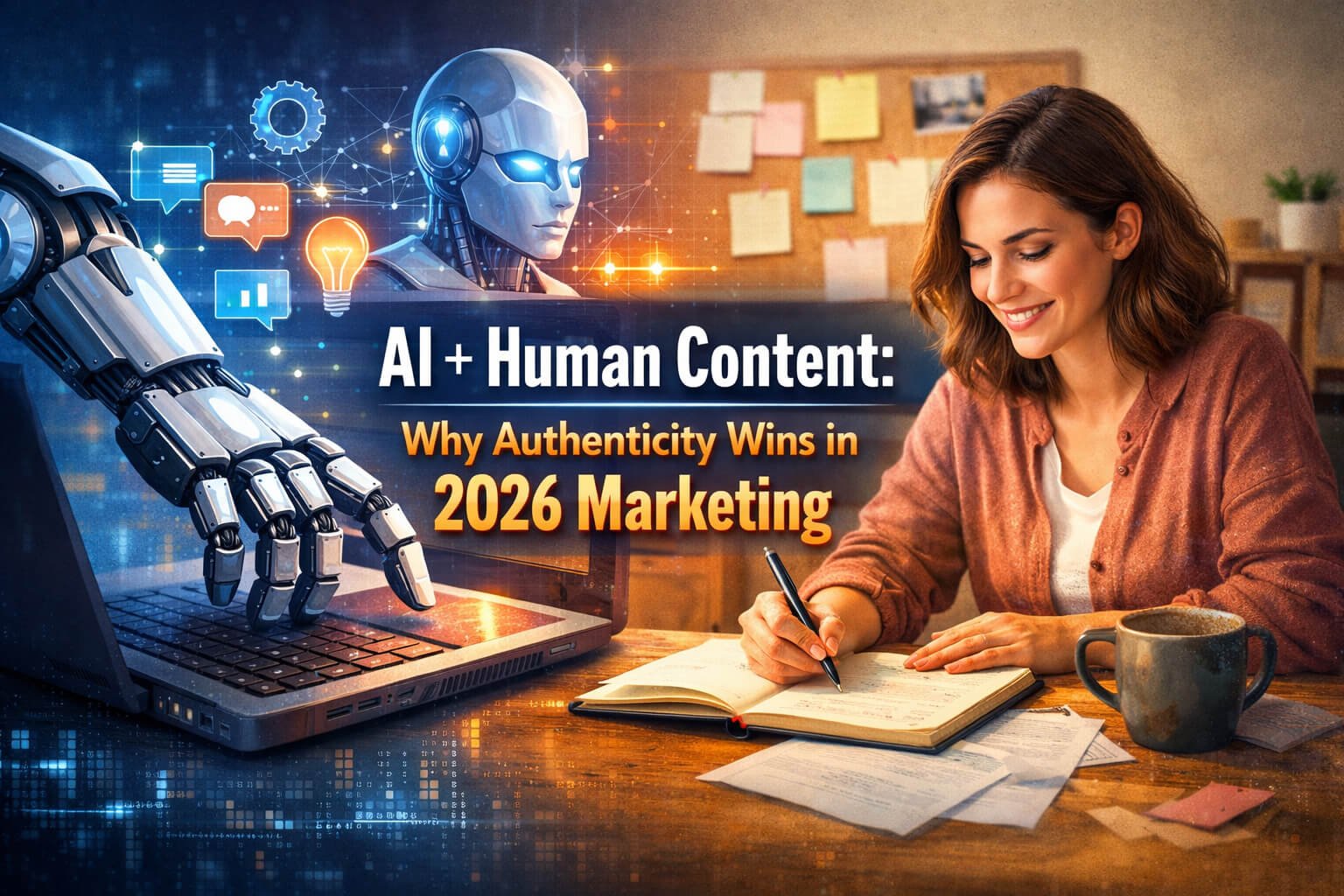
- AI provides the Skeleton: Structure, research, and data synthesis.
- Humans provide the Soul: Opinion, contrarian views, and “I was there” anecdotes.
2. From SEO to GEO (Generative Engine Optimization)
Traditional SEO focused on keywords. Modern marketing—Generative Engine Optimization (GEO)—focuses on Entity Authority.
AI models cite sources that demonstrate high E-E-A-T (Experience, Expertise, Authoritativeness, and Trustworthiness). A purely AI-generated article lacks the “Experience” element. To rank in 2026, your content needs to include:
- Case Studies: Real-world results that haven’t been indexed a thousand times before.
- Unique Frameworks: Proprietary methods (e.g., “The 3-Step Audit”) that define your brand’s specific logic.
- Human Quotes: Interviews with internal experts that provide “non-average” insights.
3. The “Uncanny Valley” of Automated Marketing
Consumers in 2026 have developed a “sixth sense” for AI-generated fluff. There is a specific cadence to purely synthetic writing—a middle-of-the-road pleasantness that feels safe but hollow.
Authenticity wins because it is imperfect. It has a voice. It takes a stand.
“In an era of deepfakes and automated outreach, a typo in a raw behind-the-scenes video or a passionate, slightly messy opinion piece is more ‘real’ than a thousand polished, AI-generated listicles.”
4. Building “Information Moats”
If your content can be replicated by a prompt, you don’t have a brand; you have a commodity. To build a “moat” around your digital presence in 2026, focus on proprietary insights.
- The “Human-in-the-Loop” Interview: Use AI to transcribe and summarize an interview, but keep the raw, unfiltered insights of the expert as the centerpiece.
- Interactive Content: AI can help code calculators or tools, but the logic behind those tools must come from human expertise.
- Community-Led Growth: Content that thrives on user-generated discussions and community feedback cannot be faked by a bot.
5. The Ethical Edge: Transparency as a Feature
In 2026, transparency is a marketing tactic. Disclosing the use of AI tools doesn’t hurt your brand; it builds trust. When you say, “This report was synthesized by AI but analyzed and verified by our Lead Strategist,” you are telling the customer that you value both efficiency and accuracy.
To reach that 1,000–1,500 word depth, we need to move beyond the “why” and dive into the “how.” Below are additional, high-impact sections to integrate into your blog. These sections focus on the technical shifts of 2026, the psychology of the modern consumer, and a step-by-step roadmap for implementation.
6. The Rise of “Proof of Experience” (PoE)
In 2026, Google’s algorithms and AI aggregators have moved past simple keyword matching to a model called Proof of Experience.
If you are writing about “B2B Lead Generation for the Electrical Industry,” a general AI will give you a generic list: LinkedIn ads, SEO, and Email marketing. To win, your human-driven content must include friction. Friction is the detail that only comes from doing the work. It sounds like:
- “We tried LinkedIn ads for a transformer manufacturer in Jaipur, and the CPL was $40 until we switched the creative to a raw factory-floor video.”
- “Most gurus say X, but in our 360° Digital Audits this year, we found that Y is actually the culprit.”
Why it works: AI models are trained on the “average” of the internet. By providing “outlier” data and specific local or industrial nuances, you become an Information Source rather than an Information Echo.
7. Cognitive Load and the “Speed of Trust”
The modern consumer is suffering from Digital Fatigue. In 2026, the average person is bombarded with thousands of AI-generated notifications, emails, and ads daily.
When a user lands on your blog, they are performing a “Vibe Check” within the first 3 seconds.
- The AI Smells: Overly formal, repetitive, “In conclusion…” summaries, and lack of formatting.
- The Human Smells: Bold opinions, conversational tone, unconventional layout, and high-value visuals (like a hand-drawn chart or a real screenshot).
To increase the Speed of Trust, your content shouldn’t just be readable; it should be scannable. Use short-form “Micro-Insights” within your long-form blog.
8. Case Study: The “Ghost Agency” vs. The “Authority Agency”
Let’s look at two hypothetical competitors in the 2026 digital marketing space:
Agency A (The Ghost): * Uses AI to pump out 30 blogs a month.
- Topics: “Top 10 SEO Tips,” “What is Digital Marketing?”
- Result: High volume, but zero citations by AI search engines. High bounce rates because the content feels “hollow.”
Agency B (The Authority): * Produces 4 deep-dive articles a month.
- Topics: “Why the ‘Zero-Click’ Era is Killing Traditional E-commerce Funnels: A Study of 50 Indian SMBs.”
- Result: Cited as a primary source by Perplexity and Gemini. High conversion rates because the “Human” element proves they actually understand the client’s pain points (like high OTA commissions in hospitality).
9. Implementation: The “Triple-Thread” Content Framework
To hit your word count while maintaining quality, use this 3-layered approach for every major point in your blog:
- The AI Layer (Data): Start with a statistic or a broad trend. (e.g., “75% of users never leave Page 1.”)
- The Human Layer (Anecdote): Add a real-world story from your agency’s experience. (e.g., “We saw this with a client in the manufacturing sector who was ranking on Page 2 and getting zero calls…”)
- The Strategic Layer (Action): Give the reader a specific, “how-to” step they can take right now.
10. The Role of Video and Voice in Written Content
In 2026, “Text” is no longer just text. To prove authenticity, embed Video Snippets or Audio Commentary within your blog.
A 30-second video of a founder explaining a complex graph does more for “Authenticity” than 5,000 words of AI text. It provides Biometric Verification—the reader can see your face, hear your tone, and verify that a real human stands behind the claim. This “Multimodal” approach is what differentiates a high-tier 2026 blog from a 2023 “content farm.”
Conclusion: The Future is “Cyborg” Marketing
The battle of “AI vs. Human” is over. AI won the battle of production, but Humans won the battle of connection.
Authenticity wins in 2026 because humans are biologically wired to seek connection with other humans. We don’t buy products; we buy the vision and the people behind them. Use AI to handle the volume, but use your humanity to handle the value.
In a world of infinite replicas, the original is priceless.
Key Takeaways for your 2026 Strategy:
- Stop chasing volume: One “Power Post” with original data beats fifty AI rehashes.
- Invest in “I”: Use first-person narratives. Talk about what your agency saw last week.
- Optimize for Citation: Write things so unique that AI models have to cite you as the source of truth.